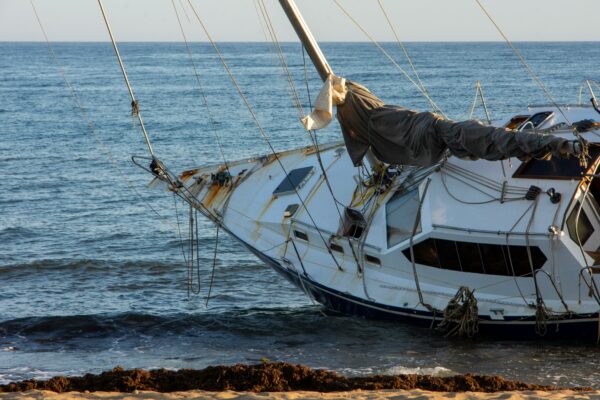
To rescue a ship in distress, some countries invest in dedicated emergency tugs, while others rely on help from tugs of opportunity in the vicinity.
In the early hours of October 17, 2014, a Canadian Coast Guard (CCG) Marine Communications and Traffic Services Centre operator in Prince Rupert, BC, noticed a vessel moving slowly and erratically, only 20 nautical miles (37 km) from the coast of Haida Gwaii, too close for safety. The vessel had lost power, the captain was injured, and the 10 crew members were working frantically to re-start the engine before the wind and waves pushed the ship carrying mining supplies and fuel onto the rocks.
The ship was the MV Simushir, a Russian-flagged cargo vessel. Within a few hours, the Simushir was drifting just 6 nautical miles (11.1 km) from shore and rolling 50 degrees in high seas. The Joint Rescue Coordination Centre in Esquimalt, BC, directed the nearby small CCG vessel Gordon Reid to respond, while the ship’s agent contracted the larger American tug Barbara Foss, located in Prince Rupert, to secure the ship and tow it to safety.
Arriving on scene the same afternoon, the Gordon Reid successfully took the Simushir in tow by 5:30 PM, after two failed attempts, and began towing the drifting vessel away from shore. The two vessels made it 20 nautical miles before the Gordon Reid’s third tow line broke at 10:50 AM the next morning and the Simushir resumed drifting. The Barbara Foss arrived on scene six hours later, nearly 40 hours after the crew of the Simushir called for help. The Simushir was towed to Prince Rupert harbour, arriving at 1:15 AM on October 20, the three-day ordeal finally over.
Disaster was averted due to the heroic efforts of the Canadian Coast Guard, supported by the Royal Canadian Navy and Air Force, the US Coast Guard, the commercial shipping industry, and a hefty dose of luck when the wind eased, but this situation, unfolding in the ancestral territory of the Haida Nation, highlighted the risks posed by ships sailing close to sensitive ecological systems along Canada’s coast yet far from the nearest rescue vessel.
The Simushir incident sparked concern and debate. It set in motion a chain of events that ultimately led to the establishment of the Voluntary Protection Zone off Haida Gwaii and Canada leasing two dedicated Emergency Towing Vessels (ETVs) in 2018 to try to prevent a similar incident in the future. The Canadian government continues to assess what the future of these two ETVs should be and what emergency response protection is needed in other parts of Canada.
Learn more about Assessing Emergency Towing Vessel Availability in Canada
In continuing to assess Canada’s emergency towing situation and develop an effective strategy from coast to coast to coast, what can we learn from around the world? What towing help is available and which countries have dedicated tugs ready to aid a ship that breaks down at sea? This article provides an overview of ETV resources — government owned or chartered — available to maritime nations like Canada, Australia, the United Kingdom, France, Norway, the United States, and others.
While there are international rules and conventions governing the rescue of crews, aid to ships in distress, and the provision places of refuge, individual nations have different approaches to providing emergency response services. This review also explores the different philosophies countries have when it comes to funding, ranging from government-financed vessels to relying on so-called “tugs of opportunity,” vessels that have other operational duties but may be called upon in an emergency.1
To understand sentiments in Canada, a Clear Seas and Angus Reid Institute public opinion poll asked in the fall of 2022 whether ETVs should be funded by taxpayers or industry, and the response was that industry should cover the costs. Three-quarters (73%) of Canadians believe it should be the responsibility of shipping companies to pay for emergency towing services. Few (13%) believe it should be a government service paid for by taxpayers.
Australia: Safeguarding an island continent
The regulation and safety of Australia’s shipping fleet and management of its international maritime obligations are under the responsibility of the Australian Maritime Safety Authority (AMSA). The agency manages emergency towage capability under the National Plan for Maritime Environmental Emergencies that covers some 34,000 kilometres of coastal waters. Towage is supported by state and territorial authorities, who manage the risks within their respective jurisdictions.
Since 2006, the country has stationed a dedicated towing vessel to protect the environmentally sensitive seas of the northern Great Barrier Reef and Torres Strait. The 82 tonnes bollard pull2 Coral Knight, a modified anchor handling tug supply vessel, was in service until 2024. Another vessel, Reef Keeper, operated from 2024 to 2026, while a dedicated new vessel was being built: a capable 120 tonne bollard pull tug with hybrid propulsion, called Reef Responder. The vessel has its home port in Cairns, Queensland, but spends most of its time patrolling at sea. The vessel is owned by Boluda Towage Australasia, operating under a 10-year emergency response services contract to be available for tasking by AMSA should a maritime incident occur.
Due to its long coastline, Australia also relies on tugs of opportunity. This was illustrated in the case of the MV Portland Bay, a 28,000-tonne bulk carrier that lost power due to engine failure 1.2 km east of the state of New South Wales’ (NSW) coast, in mid-2022. The situation was touch and go as the ship was struggling against mountainous seas towering up to 11 metres and was dangerously close to being swept into rocks along the coastline, risking an oil spill and an environmental catastrophe for the nation’s iconic Royal National Park.
Three small coastal tugs were dispatched to tow the stricken vessel further out to sea, but due to the rough water and relentless winds these efforts didn’t succeed. The decision was made to anchor the ship and hold it in place using the tugs to push back against the powerful waves and harsh weather. A break in the weather eventually allowed the ship to be safely towed to harbour. “Those smaller tugs have done amazing work over the past 24-36 hours ensuring the stricken vessel did not drift into the coastline,” said AMSA Executive Director, Response, Mark Morrow.
France: A devastating oil spill was the catalyst for a dedicated towing fleet
Stormy conditions were affecting the English Channel on March 16, 1978, when the Amoco Cadiz oil tanker was hit by a large wave and lost its steering. Determined efforts to tow it to safety were made using the West German tug Pacific, as part of a contracted salvage agreement. But, over the course of 8 hours, during which its tow line was attached, broken, and reattached, the Force 10 wind of nearly 100 km/h, combined with waves of more than 9 metres, eventually proved too much. By mid-evening, the Amoco Cadiz broke free of its tow cable, crashing into the Brittany coast and over the following two weeks its broken hull released 223,000 tonnes of oil into the ocean. It ranks as the world’s fourth largest ship-source oil spill and Europe’s worst.
Recognizing the scale of the environmental damage, the French government created an emergency towing program with Abeilles-International to ensure that four ETVs and one oil recovery vessel are always on standby. The company has a standing contract, and the tugs must be ready to deploy within 30 minutes’ notice along France’s 1,085 km long coastline — stretching from the busy shipping lanes in the English Channel to the Bay of Biscay, and the Atlantic Ocean along the northwest and the Mediterranean Sea on its southern coast. There are four assistance stations including Boulogne-sur-Mer (Haut-de-France), Cherbourg (Normandy), Brest (Brittany) and Toulon Provence-Alpes (Côte d’Azur). The English Channel is the busiest maritime corridor in the world and subject to difficult conditions including strong currents, bad weather and an irregular coastline that presents many hazards.

The tugs are chartered by the French Navy and at the service of the French government. Maritime prefects on each coast direct their operation. Les Abeilles also works with the Maritime Rescue Coordinating Centre, located at Griz-Nez, to assist in rescue operations. In 2022, the company launched two new vessels – the Abeille Méditerranée and its sister ship the Abeille Normandie. They each have a bollard pull of 280 tonnes and can carry up to 300 people in rescue operations.
France’s emergency towing vessel fleet
| Ship | Bollard Pull | Location | Role |
| Abeille Normandie | 280 tonnes | Atlantic | ETV/fire |
| Abeille Liberté | 209 tonnes | Atlantic | ETV/fire |
| Abeille Bourbon | 209 tonnes | Atlantic | ETV/fire |
| Abeille Méditerranée | 280 tonnes | Mediterranean | ETV/fire |
| Abeille Jason | 126 tonnes | Mediterranean | Oil spill response/fire |
Since the program was established, the company says it has prevented as many as 50 major incidents that might have rivalled the Amoco Cadiz. In recent years, they have also added a humanitarian element to help rescue migrants seeking to reach the United Kingdom.
The French navy is also deploying six multi-purpose patrol vessels in its overseas territories, including Saint-Pierre and Miquelon, just 19 km off the southern coast of Newfoundland, that have a range of missions including protecting sovereignty, fighting human and drug trafficking, and emergency towing. Canada and France cooperate on joint rescues in these waters and have trained together as far away as the inland waters of Lake Ontario.
United Kingdom: Emergency towing fleet reduced to a single vessel
Across the English Channel, the United Kingdom created a dedicated fleet of four ETVs in 1994 in response to the grounding of the MV Braer off the Shetland Islands the year before during a hurricane, which spilled 85,000 tonnes of crude oil and killed some 1,500 seabirds. The government subsequently disbanded the national fleet of towing vessels in 2011 in response to rising costs and budgetary pressures, arguing that commercial vessels would be available to help in an emergency. Successful lobbying by Scottish MPs ensured that one tug was kept for the Scottish coast.3 The Italian-flagged levoli Black, based in Stornoway, Scotland was contracted for this role. The rest of the nation now relies on the availability of commercial tugs or assistance from French ETVs in the English Channel.
David Appleton, a professional and technical officer with Nautilus International, a union representing mariners in the UK and Europe, said: “The increasing size and complexity of ships and their cargoes, as well as the growing frequency of adverse weather conditions around the UK coast, underlines the importance of the protection that [the dedicated fleet of ETVs] provides.” He added that, “while the government’s cost benefit analysis that savings [from eliminating the ETVs] would amount to £32 million (almost CDN$53 million) over four years… this would still be an insignificant amount when compared to a major clean-up operation.”
The danger of a lack of ETV resources was underlined by an independent report that was produced for the UK’s Maritime and Coastguard Agency. It was in response to a Marine Accident Investigation Branch (MAIB) report on a collision in the English Channel in November 2016 between the 29,000-tonne cargo ship MV Saga Sky and a rock-carrying barge. The two vessels were caught in storm force winds and although a small harbour tug was sent out to aid, it was overwhelmed by the nearly 130 km/h winds. That collision resulted in Britain losing some of its power supply from France because two of four of the France-Angleterre 1 high voltage lines were severed as the vessels dragged their anchors over the cables. Repairs to the cables reportedly cost between CDN$49 to $66 million.
The MAIB recommended a reassessment of the need for the Maritime and Coast Guard Agency to “Commission a study to review the full range of emergency response assets available in the Dover Strait (the narrowest part of the English Channel), including a reassessment of the need for a dedicated emergency towing capability.”4
Norway: Dual-purpose ships and digitalization reducing risk
At just under 100,000 km, Norway has the third longest coastline in the world after Canada and Indonesia. Norway had a series of maritime accidents in the 1990s that highlighted a lack of commercial tug resources in its remote and hostile waters to provide emergency assistance.
Based on an extensive analysis, Norway created the Norwegian Emergency Towing Service or NETS in 2003. It was established as a cooperative venture between the Norwegian Coast Guard and the Norwegian Coastal Administration (NCA).
Originally, operations were contained to the northern coast, but in 2009 it was expanded to the southern coast. The Norwegian Coast Guard owns three Barentshav class offshore patrol vessels, each armed with a 40-mm Bofors gun and crewed by military and civilian personnel. They also operate another multi-purpose vessel named NoCGV Harstad on charter.
Norway’s dual-purpose approach requiring its coast guard vessels to also be capable of providing emergency towing assistance is paired with a sophisticated real-time risk management system that monitors the outer routes where the vessels – mostly tankers – with the greatest pollution potential are sailing. Together with SINTEF Energy Research Institute, the NCA and Coast Guard have developed an analytical tool, based on simulations that consider varying parameters, such as wind direction and strength, as well as an ongoing assessment of the risk picture associated with shipping traffic. This tool provides a real-time picture of the risk along the Norwegian coast and allows marine authorities to predict and deploy resources to where they will most likely be required.
Spain and Germany: Relying on dedicated and chartered vessels
In Spain, the Maritime Safety and Rescue Society is responsible for ETVs. The organization oversees maritime traffic control, search and rescue operations, and protection of the maritime environment operating 14 tugs of various sizes in the Atlantic and Mediterranean. They can also charter an additional ETV if needed. Germany requires that ETVs must be on-scene within two hours of a distress call. They operate eight ETVs, four of which are part of the German Coast Guard and four others on contract to the German government from tug companies. They patrol and serve German waters in the North and Baltic Seas.
United States: Ship operators required to have towing contract in American waters
Overall, emergency towing response in the United States is governed under the Oil Pollution Act (OPA) of 1990, which like so many other nations’ approaches was enacted in the wake of a major oil spill, in this case, the 1989 Exxon Valdez disaster in Alaska. The US regulatory regime requires that vessel owners and operators take a proactive stance on emergency response and have a contract with a spill response and emergency towing company.
In the Pacific Northwest, Washington state requires industry to support a dedicated ETV. The contract system requires a tug on standby in Neah Bay, WA at all times. If the tug is called to respond to an emergency, another vessel is stationed at Neah Bay so one of sufficient capability is always available. Brian Kirk, prevention section manager with the Spills Prevention, Preparedness, and Response Program at the Washington State Department of Ecology, says that the operational management of an incident can vary, depending on the situation and the location of the vessel in distress. In many cases, the vessel operating company will choose to charter a tug. “The tug filling the ETV role at Neah Bay, may be closest or most suitable to respond, and frequently will be the tug that is put on contract. In these cases, the towing company that operates the ETV is obligated to back fill that capability with another tug, including moving a tug out to Neah Bay.”
Clear Seas leads a peer review that will help guide emergency towing
Continuing from the “West Coast Emergency Towing Needs Assessment” prepared for the Canadian Coast Guard in 2019, the Canadian government is developing a long-term national approach for marine emergency towing to understand how to best meet emergency towing requirements on all three coasts. The strategy will consider regional needs, the perspectives of Indigenous Peoples, partners and stakeholders, and lessons learned from the operations of the Atlantic Eagle and Atlantic Raven on the Pacific coast.

A Marine Navigation Risk Assessment (MNRA) methodology was developed by Transport Canada and the Coast Guard under the Oceans Protection Plan with input from the Regional Technical Team under the Reconciliation Framework Agreement. The MNRA was intended to answer questions about where ships could be disabled and get into accidents and understand existing towing capacity in high-risk areas.
In the spring of 2022, Clear Seas led a peer review of the MNRA methodology, convening a panel of academic, industry, and Indigenous experts to review the methodology and provide actionable recommendations to ensure the process would be technically robust, to an international level of quality, and appropriate to answer the intended research questions.
What’s next for emergency towing in Canadian waters?
The federal government is developing potential new regulations to increase access to marine emergency services and improve response to pollution incidents in Canada.55 The intention is to create a cohesive, national system to improve preparedness, response, and recovery for all marine pollution events.
In 2025, Clear Seas undertook a national assessment of ETV availability and capability to contribute to the development of these regulations. The report, Assessing Emergency Towing Vessel Availability in Canada, concludes that while some capable vessels are present in Canadian waters, their availability is constrained by long-term commercial commitments. Geographic coverage is uneven, with some capacity in the Pacific but significant gaps in the Arctic and Atlantic. Expert contributors emphasized that “tugs of opportunity” – where a vessel in distress calls on a nearby vessel for aid in an emergency – should not be assumed to be available in an emergency, as redeployment is often impractical.
The conversation on appropriate levels of emergency towing services in Canadian waters, including tow vessel capability, distribution, and contract terms, continues, with the goal of keeping our sensitive coastal ecosystems safe for generations to come.
References
- While this review provides information about specific tugs, their pulling power varies with the size of ships, their tonnage, waves, winds, and other conditions that may be encountered during a rescue. ↩︎
- Bollard pull is a commonly used measure of a tug’s pulling power and is expressed in metric tonnes (MT). Bollard pull is the measure of the pulling force that a tug can apply when tied to a fixed object such as a dock. It is measured using a set of test protocols such as those developed by Det Norske Veritas (2001) and a load cell instrument that measures the force of pull exerted on a tow line. Clear Seas Centre for Responsible Marine Shipping. (2019). Availability of Tugs of Opportunity in Canada’s Pacific Region. p. 2 ↩︎
- Ben Webster, The Times, April 3, 2018: Coast facing oil spill peril after fleet of rescue tugs was scrapped. ↩︎
- Accident Report, Marine Accident Investigation Branch, Report on the investigation of the collision between Saga Sky and Stema Barge II English Channel, off the Kent Coast on 20 November 2016, p. 36 ↩︎
- Transport Canada, July 25, 2022: Potential regulations to increase access to marine emergency services and improve marine pollution preparedness, response and recovery. ↩︎