On National Indigenous Peoples Day, we’re reflecting on the importance of family, community, traditional practices, and art.
|
Getting your Trinity Audio player ready...
|
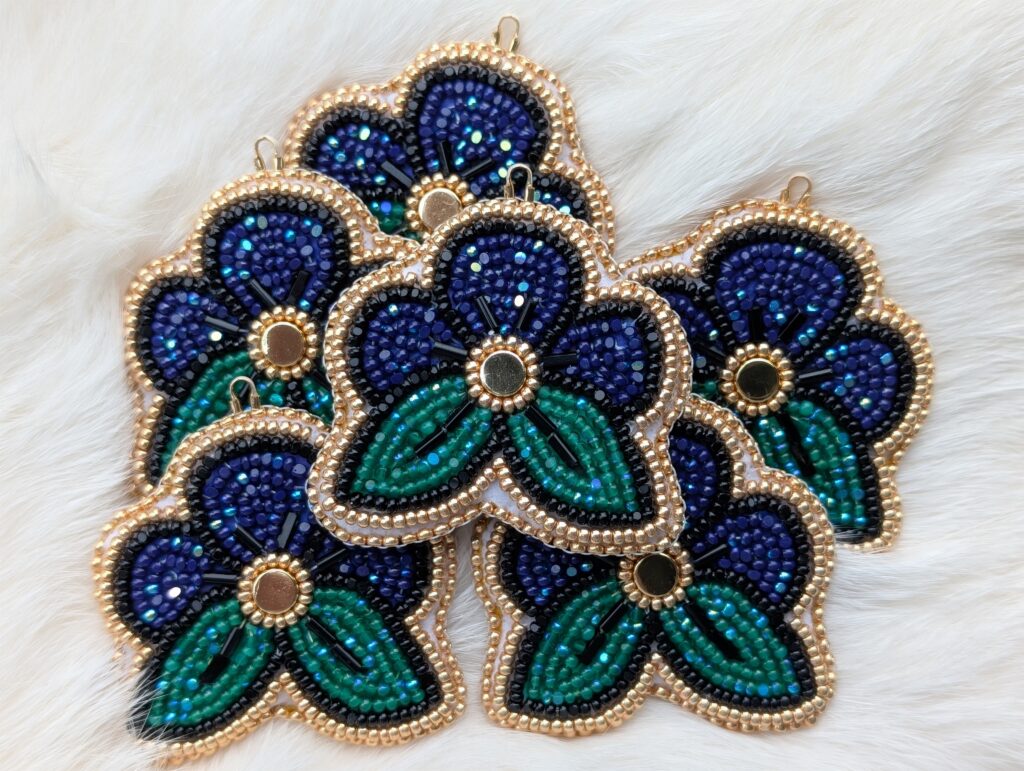
I am a mixed European and Indigenous beadwork artist. I am Italian and Irish on my mom’s side, and, on my dad’s side, my Indigenous roots are Saulteaux, Cree, and Métis. I am a member of Sapotaweyak Cree Nation, Treaty 4 territory, located near Lake Winnipegosis in Manitoba. By many measures, you could say I am a reconnecting Indigenous person. It has been a long journey, but along the way I have met new family members, heard great stories, and learned more about where I come from.
I started beading about seven years ago after going through my grandmother’s belongings. Among her things, I found beautiful handmade Cree and Métis floral embroideries and an impressively large Ojibwe Star Blanket that had been given to my mother on her wedding day by my great-grandmother. Holding those pieces, I realized they were more than family heirlooms. They were a connection to generations of women in my family and to a part of myself I had not fully appreciated nor explored. In that moment, I felt there was an entire history waiting to be rediscovered.
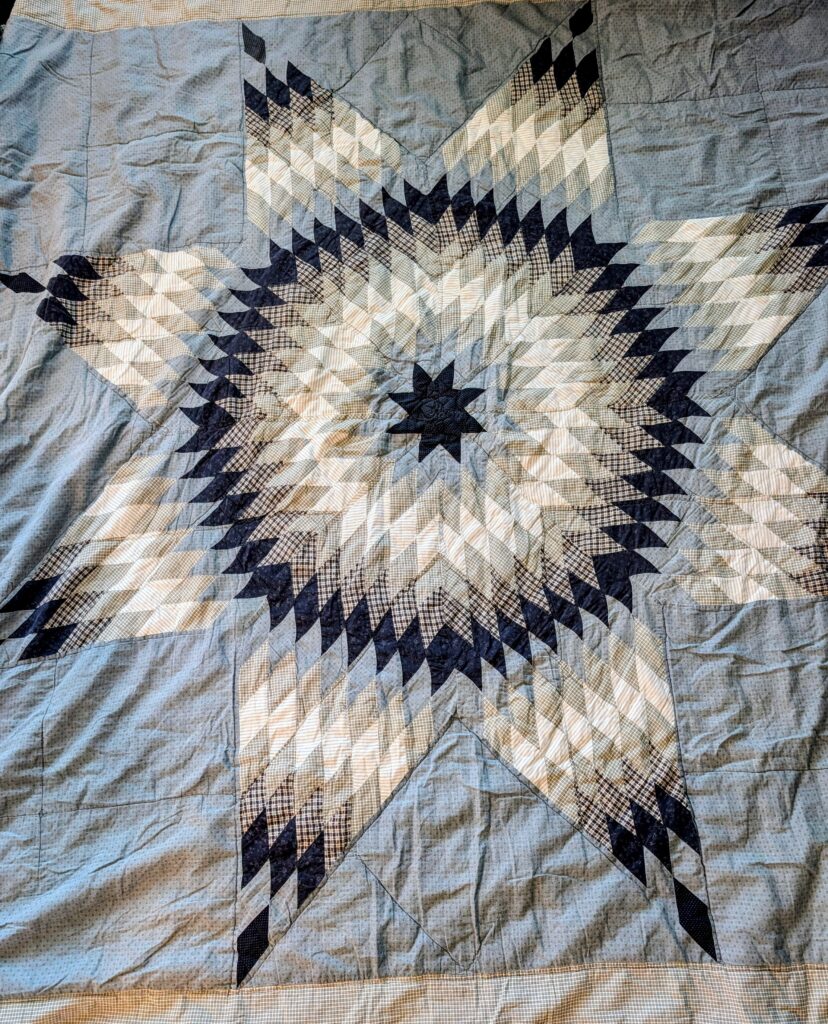
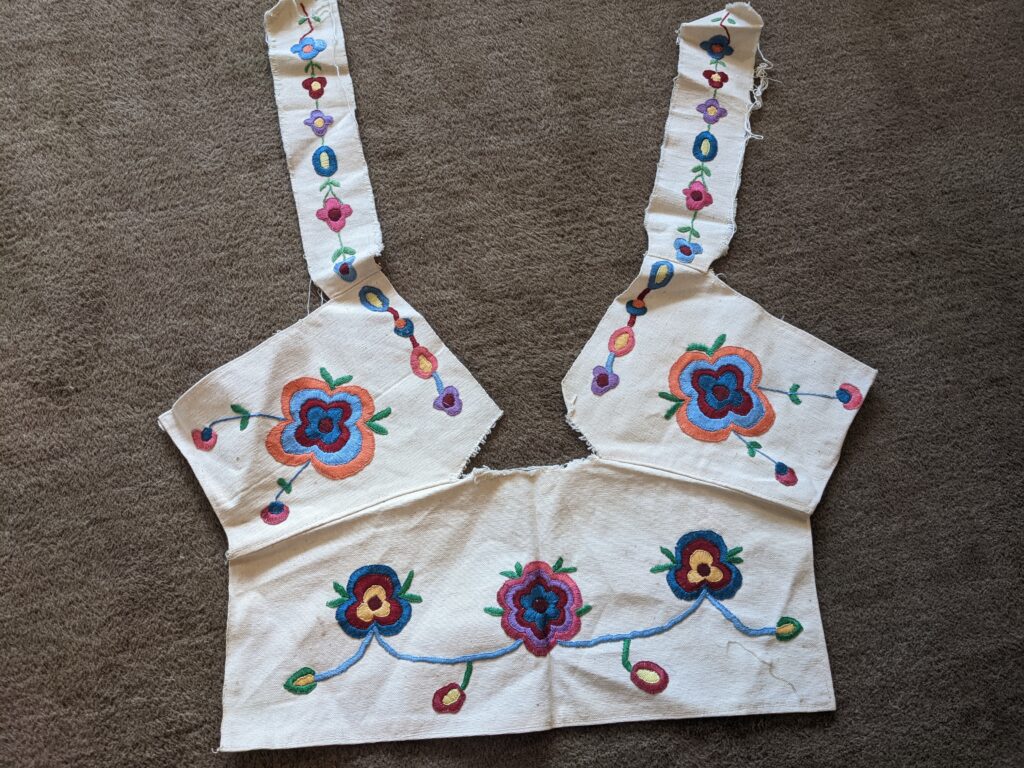
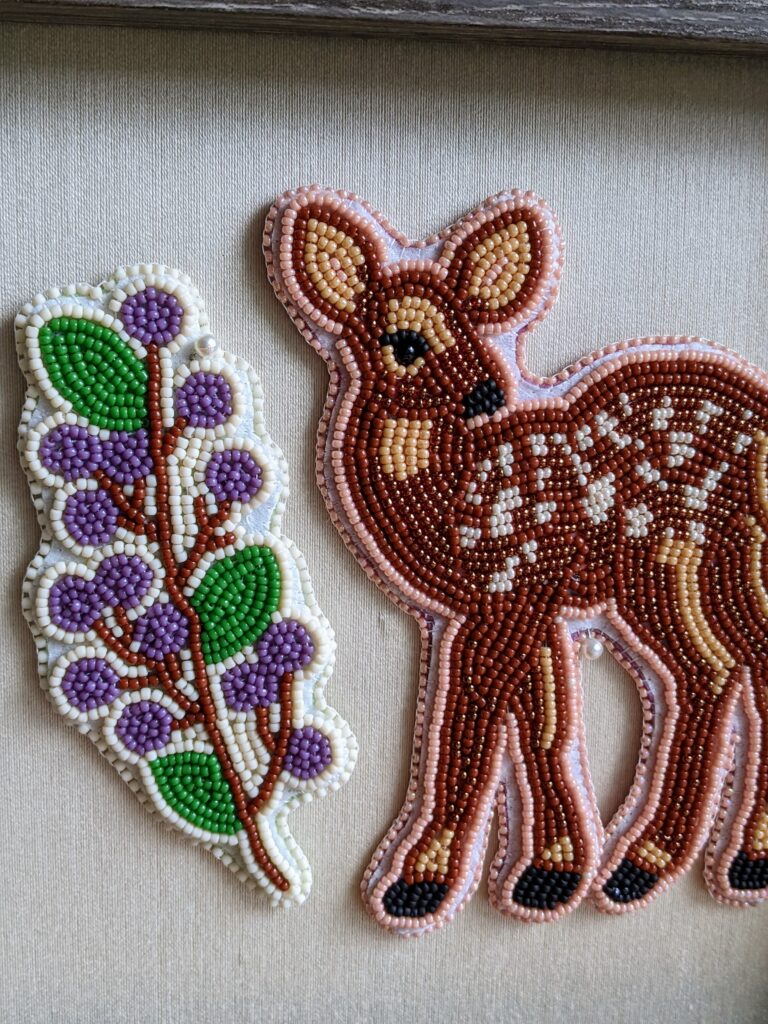
Left photo: An Ojibwe Star Blanket by Stephanie’s Great-Great Grandmother Kathleen Munro. Often gifted to mark important life milestones, Star Blankets are symbols of honour, protection, and blessings. Middle photo: Jacket panels from the 1930s embroidered with traditional Cree-Métis floral designs. These pieces inspired Stephanie’s exploration of beadwork and cultural reconnection. Right photo: A Saskatoon berry branch and fawn inspired by Stephanie’s grandmother, who grew up in Treaty 4 territory and whose family once adopted a young fawn.
As I followed that feeling, I became drawn to traditional beadwork, inspired by the floral jacket panels I found among my grandmother’s things. I later showed them to Métis art expert, Gregory Scofield, who believed they were unfinished works in progress made in the early 1930s.
For me, beading is more than a pasttime. It is a way to connect with my ancestors and with my grandmother, who I miss so much. Every piece I create feels like a memory come back to life, a conversation across generations, and a feeling of hope and joy.
Nature has always been at the heart of my work. Growing up in the Kootenays, in Ktunaxa Territory, I spent as much time outdoors as I could. I remember hunting with my Dad and being in awe of the herds of elk and white-tailed deer moving through the landscape, tiny wild strawberries that seemed to stretch on forever, and Saskatoon berries that we would gather and spoon over ice cream back at our campsite. Those berries often find their way into my beadwork today.
Fishing with my family is one of my happiest childhood memories. Now, I often bead rainbow trout inspired by the fish we caught and their iridescent colours. Even now, when I bead their luminous scales, I am reminded of those moments on the waters of Lake Koocanusa.
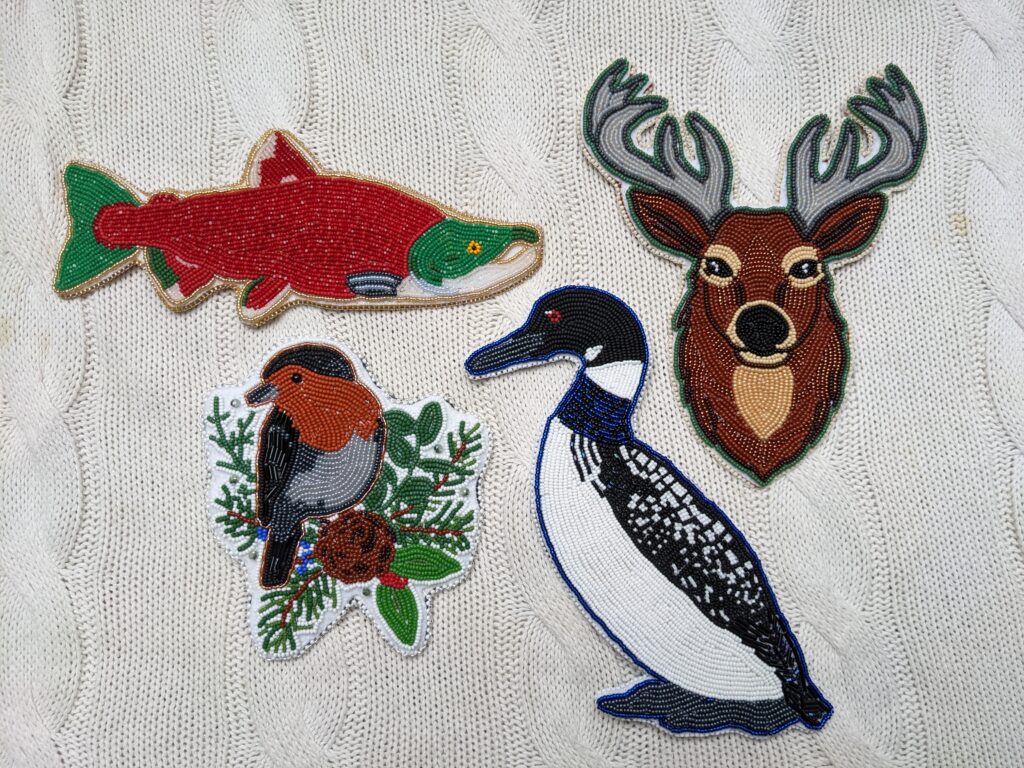
A collection of large beadwork pieces by Stephanie featuring a loon, elk, robin, and salmon inspired by family stories, memories, and photographs.
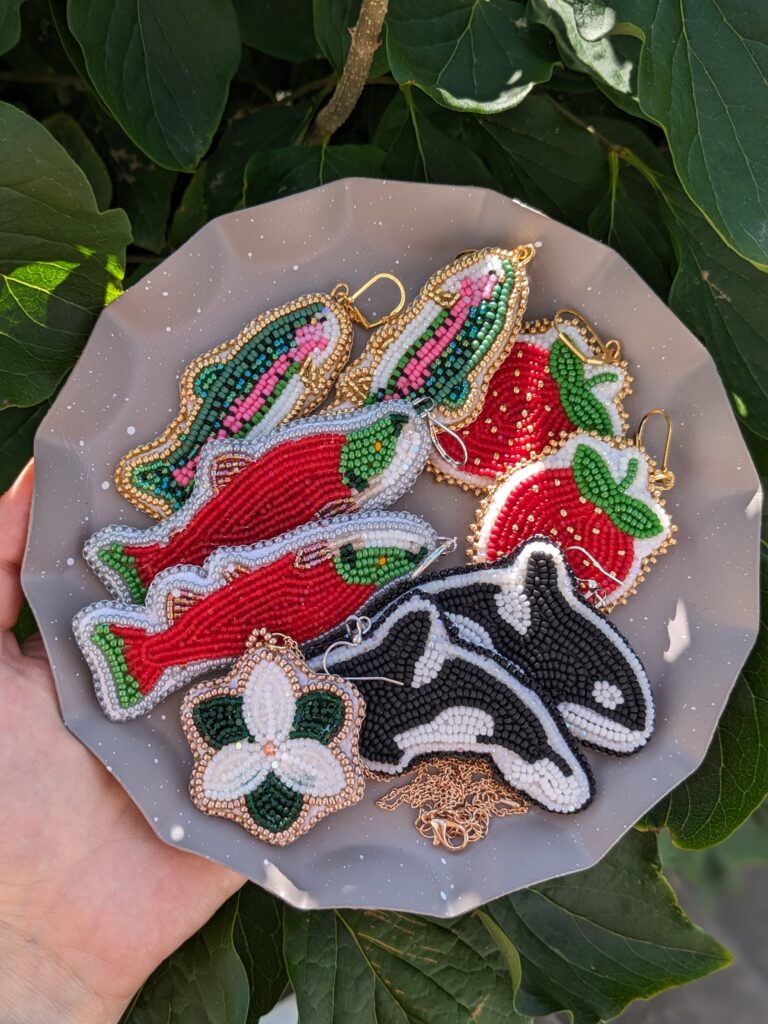
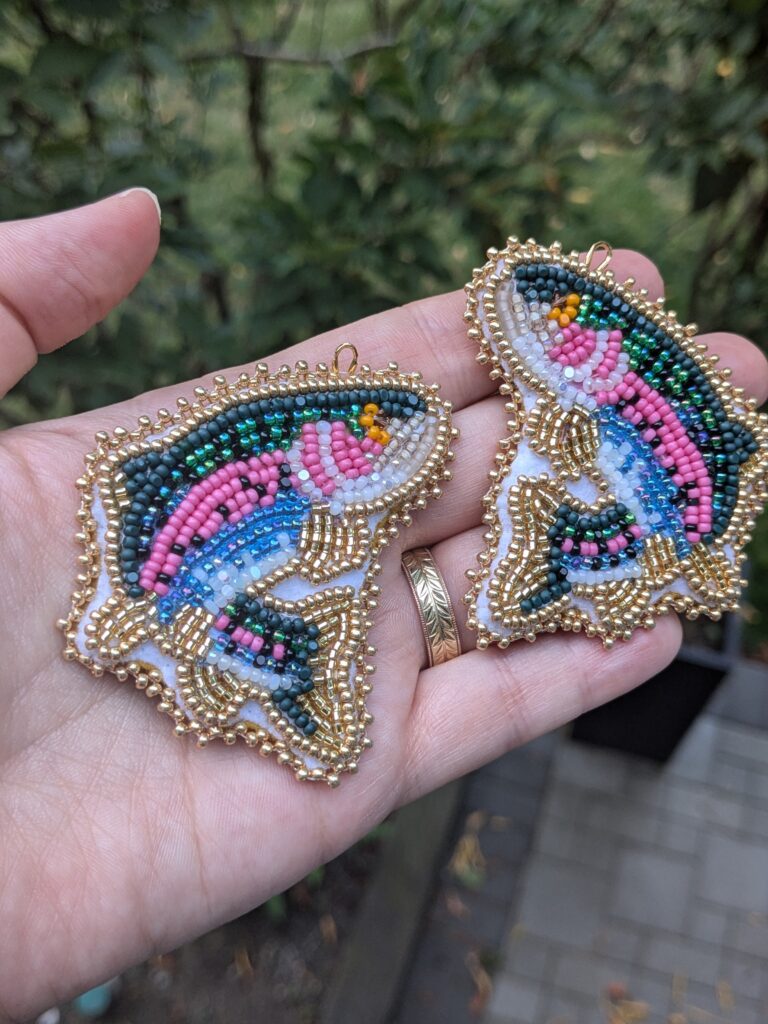
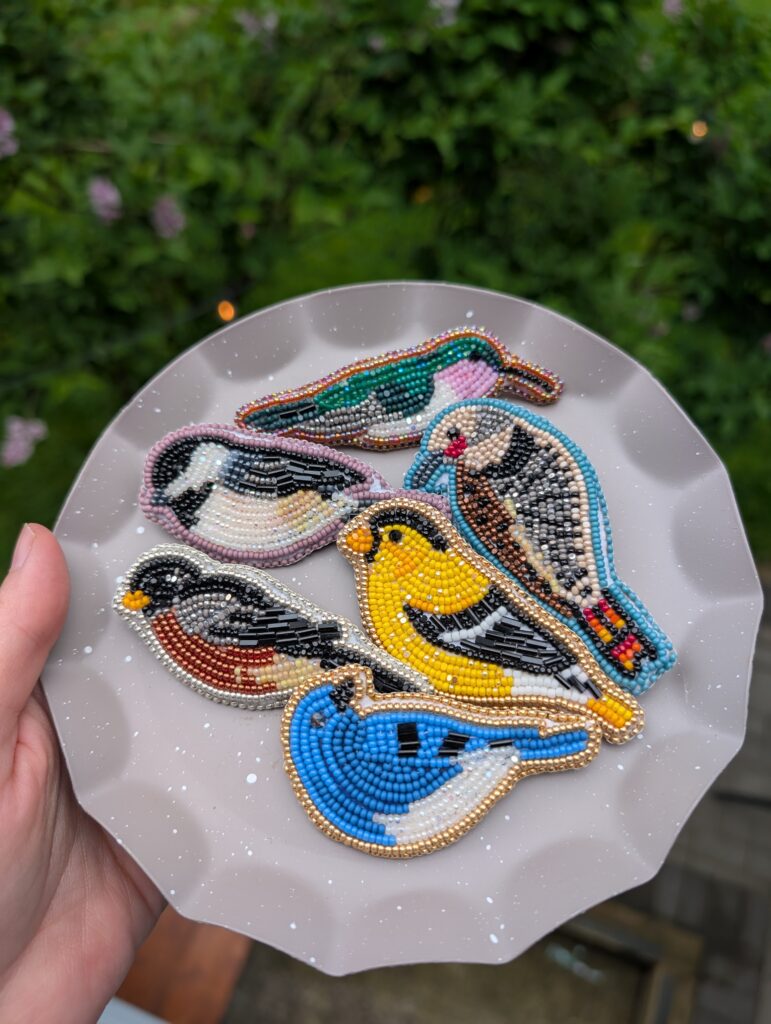
Beaded earrings inspired by the birds, fish, and wildlife that have shaped Stephanie’s connection to place, from the Rocky Mountains of her childhood to the Pacific Northwest coast she now calls home.
Today I live in Coast Salish Territory, and the natural world continues to shape my work. I am inspired by the sockeye salmon that my children and I release as fry in the spring and watch return in the fall. Their vibrant reds and shimmering greens as they make their final journey home show me spirit and strength, the importance carrying on for future generations even when we are near our own end.
I am inspired by the orcas of the Salish Sea and their matrilineal family ties, by the little hummingbirds that visit my flowers, by Northern Flickers in my yard, and by the trilliums that bloom each spring on the trails I walk.
From my earliest memories in the Rocky Mountains to the experiences along the coastlines of the Pacific Ocean I now share with my daughters, I find inspiration in nature, family, and the stories that connect us. I am grateful to have inherited these pieces of my family’s history and to honour them through the work I create today.
As I reflect on the traditions that were interrupted between my great-grandmother, my grandmother, and me, I think about how I never had the chance to learn from my great-grandmother Kathleen, whose name I carry, or hear her speak her language because of the impacts of colonization. There is loss in that.
But there is also resilience.
Through beadwork, I have found a way to reconnect. I have found a way to honour my ancestors, celebrate the beauty of the lands and waters that have shaped my life, and carry forward traditions that nearly slipped away.
I am grateful to be part of a vibrant community of Indigenous artists who continue to share their knowledge, creativity, and culture. Every bead I hold reminds me that these stories, connections, and traditions are still here. They live in the work we create, in the teachings we share, and in the generations that have come before and will follow us.
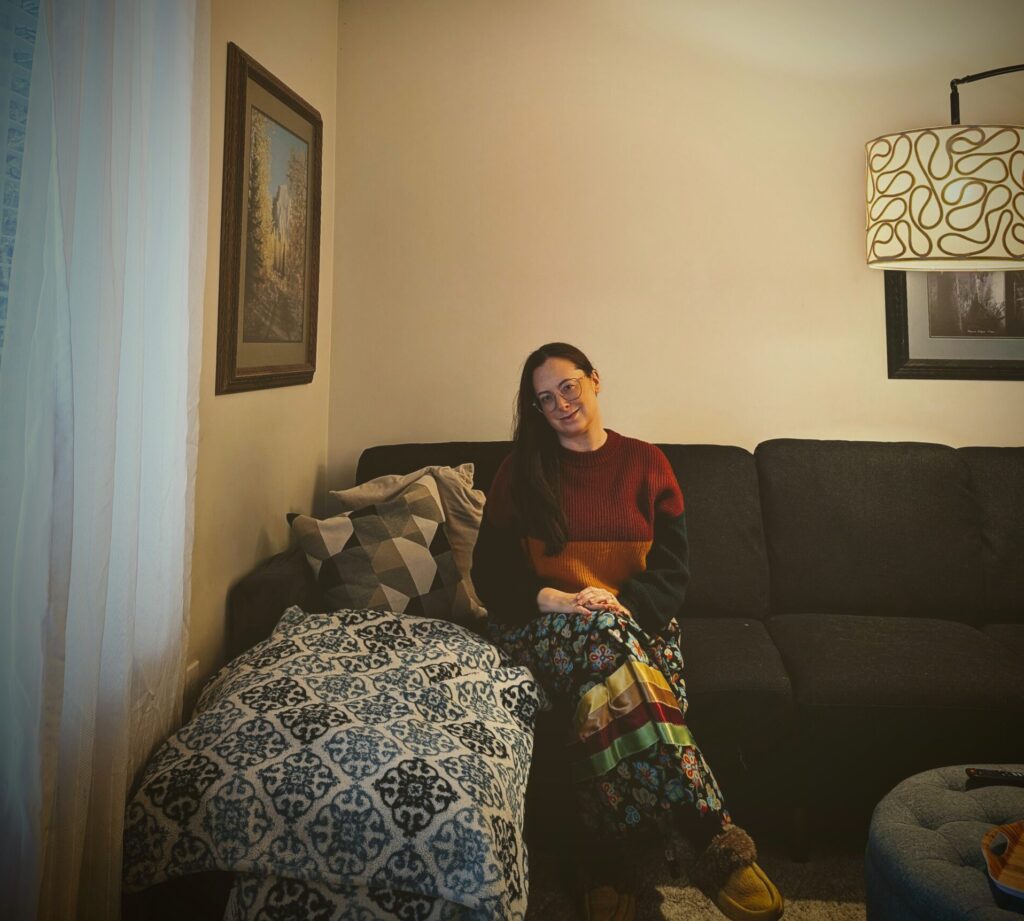
Stephanie Hurlburt is a member of Sapotaweyak Cree Nation. She lives in Port Moody, British Columbia, with her husband and two daughters on the ancestral and unceded territory of the kʷikʷəƛ̓əm (Kwikwetlem) First Nation, and within the shared territories of the səlilwətaɬ (Tsleil-Waututh), xʷməθkʷəy̓əm (Musqueam), Sḵwx̱wú7mesh (Squamish), q̓ic̓əy̓ (Katzie), qʼʷa:n̓ƛʼən̓ (Kwantlen), qiqéyt (Qayqayt), and Stó:lō Nations.
She is a beadwork artist whose work is inspired by the lands, waters, plants, and animals that surround us. You can find her work on Instagram @stephanie.k.beadwork