La mesure précise du bruit sous-marin, à l’aide d’hydrophones et de portées acoustiques, est essentielle pour les chercheurs, les régulateurs et les opérateurs de navires afin de comprendre l’impact du bruit sur la vie marine.
|
Getting your Trinity Audio player ready...
|
Click to view glossary
Reducing underwater vessel noise requires tools to detect and measure it. For researchers, accurate measurements are vital for understanding how noise affects marine life and ecosystems and for evaluating the effectiveness of different noise reduction solutions. For regulators, measurement is essential to address human-made noise sources – identifying problematic areas, establishing baselines for noise management plans, and supporting effective noise reduction measures. For vessel owners and operators, these measurements help them to identify the best approaches to reduce their vessels’ underwater noise footprint.
Projects funded through the Quiet Vessel Initiative have explored various methods for detecting, measuring, and analyzing underwater radiated noise, including remote and onboard solutions.
Underwater noise is measured using an instrument called a hydrophone (underwater microphone). Hydrophones can be deployed individually, in groups, or a line horizontally or vertically at different depths. To ensure consist measurements between different hydrophones in different locations, the International Maritime Organization has published revised guidelines that include noise measurement standards.1
As a ship passes a hydrophone, the noise it emits is recorded. By knowing how far the hydrophone is from the vessel at different points, researchers and data analysts can use the recorded sound level and account for distance travelled and reflections at the water surface and seafloor to calculate how loud the sound was when it left the vessel. Environmental factors, such as wind, currents, rain, and temperature, are also recorded and accounted for in the noise measurement calculations. These corrected sound measurements make comparisons between vessels, locations, and seasons more accurate.
What are hydrophones measuring?
Hydrophones detect pressure changes in the water caused by sound waves. These sensors convert the underwater pressure fluctuations into electrical signals, which can then be analyzed to determine the properties of sound, such as amplitude and frequency. This is similar to how our ears work. The measurement of underwater vessel noise by hydrophones is used to understand sound intensity (the amount of sound energy passing through an area at a given time) and sound pressure level (representing the average variation in pressure caused by the sound) expressed in decibels. The decibel scale uses different reference pressures in air and in water, so comparing decibel measurements between the two can be misleading. A sound that seems relatively quiet in air can be perceived as loud underwater. Measurements taken with hydrophones are used to determine the source level of sound, or the amount of sound if it were measured at a distance of 1 metre (3 feet) from the ship, rather than at the distance actually required when using a hydrophone.
Underwater acoustic ranges
Underwater acoustic ranges are arrays of hydrophones placed in the water to measure sound. They may consist of a single hydrophone or several hydrophones in a line or other configuration. Acoustic ranges can be permanent fixtures or deployed temporarily.
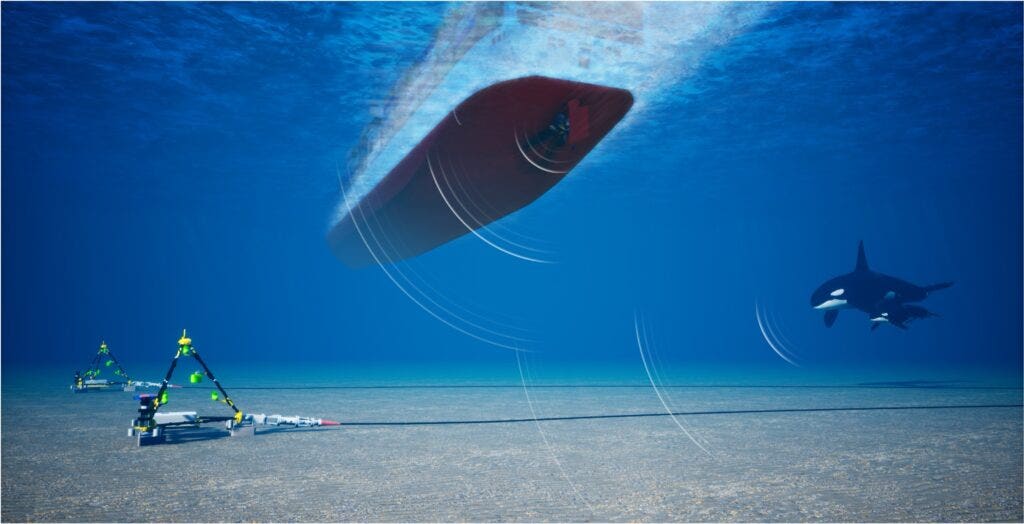
When a vessel owner wants to measure the noise level of their vessel at an acoustic range, they undertake a process called ranging. The vessel travels past the hydrophone(s) in one direction at a constant engine power and then back again. The vessel may make several back-and-forth trips to measure noise at different engine levels and machinery configurations. Additionally, they may moor the ship at a specific location, turn off all the ship’s equipment and engines, and then, one at a time, switch different pieces of equipment on and off. This is known as static ranging, useful for measuring how noisy different pieces of onboard equipment or machinery are. Acoustic ranges may also be used for long-term passive monitoring of underwater vessel noise and ambient (background) ocean noise as well as for identifying marine life in the area.
One of the key benefits of acoustic ranges is relatively consistent measurements. This means you can compare different vessels, operational parameters, vessel designs, and seasonal influences. Moreover, depending on the placement of the hydrophones, researchers can create an accurate picture of the soundscape – the collected sounds of an area.
Calling vessel owners & operators: participate in underwater noise measurements!
If you are a Salish Sea vessel owner or operator and are interested in ranging your vessels or obtaining an opportunistic measurement of your vessel as it transits through Boundary Pass, please contact the Transport Canada QVI team at Marine-RDD-maritime@tc.gc.ca.
Spotlight: The Boundary Pass Underwater Listening Station
Some 190 metres (600 feet) below the shipping lanes in Boundary Pass, a 23-kilometre-long strait along the boundary between British Columbia, Canada, and Washington, USA, lies an underwater listening station equipped with multiple hydrophones. Deployed by JASCO Applied Sciences (watch the video), the Boundary Pass Underwater Listening Station includes two hydrophone arrays, each equipped with four active hydrophones (plus more as back-up), a video camera, and ocean temperature, salinity, and current sensors. The station is linked to the shore with fibre-optic cables, allowing data to be shared and processed in near real-time.
“The Boundary Pass Listening Station is critical for understanding the noise emissions of the world’s commercial vessel fleet and its impact on the environment. By helping to define noise thresholds for international quiet ship certifications, these measurements will lead to noise savings for all the world’s oceans—an essential goal for ensuring the health and survival of at-risk species, including our Southern Resident killer whales.”
David Hannay, JASCO’s Chief Science Officer
The strait and surrounding Salish Sea provide critical habitat for endangered Southern Resident killer whales. Underwater vessel noise is a significant threat to their survival and recovery. Funded by Transport Canada and in collaboration with the Port of Vancouver’s Enhancing Cetacean Habitat and Observation (ECHO) Program, the station gathers data to measure underwater noise from commercial ships, to detect marine mammals near shipping lanes, and to track ambient ocean noise levels over time.
Starting in May 2020, the station has collected underwater vessel noise data from nearly 10,000 unique vessels making over 62,000 passes, creating one of the world’s largest databases of vessel noise. This underwater noise data set is being studied, in combination with other data, including weather, photos and videos, and vessel speed and position from AIS (Automatic Identification System), to support research in several areas. Research applications include tracking individual whales, identifying fish sounds, characterizing marine habitat over time, quietening commercial vessels, and tracking small vessels without AIS transponders.
This article is part of a five articles series on technology for detecting and analysing underwater vessel noise.
Continue learning about the new discoveries and challenges in making vessels quieter with the other topics in this series here
The Quiet Vessel Initiative is a federally funded program through Transport Canada. Industry partners and researchers interested in potential research and development collaborations to advance innovative solutions in marine technology are invited to contact the Quiet Vessel Initiative team at Marine-RDD-maritime@tc.gc.ca.
Featured image credit: Keith Luke via Unsplash
- Les armateurs, les concepteurs, les exploitants et les autres intervenants peuvent utiliser la norme de mesure du bruit la plus appropriée et la plus récente figurant dans les directives révisées de l’OMI sur la réduction du bruit sous-marin produit par les navires en vue de remédier aux effets néfastes sur la vie marine. ↩︎