
Marine Shipping And You
It all seems so far removed from marine shipping. But when you consider that an estimated 70-80% of the items that we are surrounded by and use daily are brought to us by ship it is clear that Canadians rely on marine shipping.
Even if you don’t live by a coast, your day-to-day life depends on marine shipping. And when considering some of the issues surrounding marine shipping, it’s important to do so knowing how it influences our lives and impacts the country’s economy.
This site was created by Clear Seas Centre for Responsible Marine Shipping to provide information on the role of marine shipping in our lives.
A Ship Brought It
Essentially, any product in your life from somewhere other than North America likely came by ship.



In 2015, Canadian Tire, the 22nd largest importer in North America, imported more than 29,000 cargo containers.
Included were goods such as sporting equipment, hardware, electronics, housewares, tires, and auto accessories.
Around 90% of them were shipped through the Port of Vancouver, making Canadian Tire the port’s largest importer (by number of containers).
A Ship Took It
Canadians also rely on ships to export their products to the rest of the world.
Getting goods to international markets – or exporting – is essential to Canada’s prosperity and everyday marine shipping facilitates this.
From the small independent retailer to the global manufacturer – if you need your product to reach a market outside of North America it is likely that you will need to rely on marine shipping.
Top 15 Marine Export Commodities by Total Value, 2006 – 2015
| Commodity Type | Total Value ($B) | Share (%) |
|---|---|---|
| Mineral fuels, oils and products of distillation; bituminous subs; mineral waxes | 254.4 | 28.8 |
| Ores, slag and ash | 69.1 | 7.8 |
| Cereals | 58.3 | 6.6 |
| Oil seed and oleaginous fruits; grains, seeds and fruit; ind and medicinal plants; straw | 51.9 | 5.9 |
| Nickel and articles thereof | 44.9 | 5.1 |
| Pulp of wood / of other fibrous cellulosic materials; recovered waste | 41.3 | 4.7 |
| Machinery, boilers, mechanical appliances, engines, parts | 34.8 | 3.9 |
| Wood and articles of wood; wood charcoal | 32.2 | 3.6 |
| Fertilizers | 24.1 | 2.7 |
| Edible vegetables and certain roots and tubers | 21.0 | 2.4 |
| Meat and edible meat offal | 20.6 | 2.3 |
| Paper and paperboard; articles of paper pulp, of paper or of paperboard | 19.0 | 2.1 |
| Aluminum and articles thereof | 18.4 | 2.1 |
| Organic chemicals | 14.5 | 1.6 |
| Iron and steel | 13.3 | 1.5 |
Indispensable to the Canadian Economy
Without marine shipping, Canada would be a different place economically.
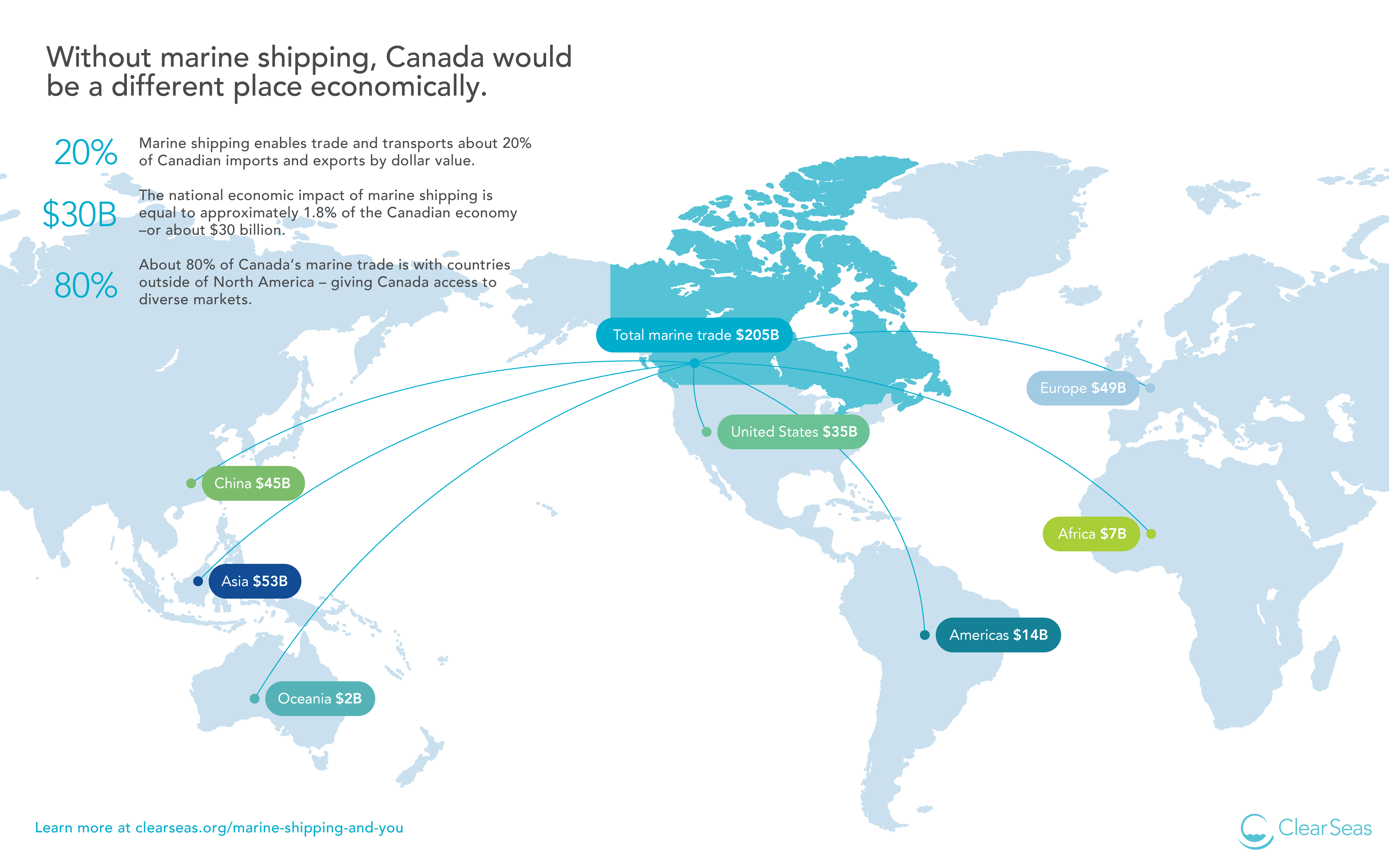
20%
Marine shipping enables trade and transports about 20% of Canadian imports and exports by dollar value.
$30B
The national economic impact of marine shipping is equal to approximately 1.8% of the Canadian economy – or about $30 billion.
80%
About 80% of Canada’s marine trade is with countries outside of North America – giving Canada access to diverse markets.
More information on the Value of Commercial Marine Shipping to Canada.
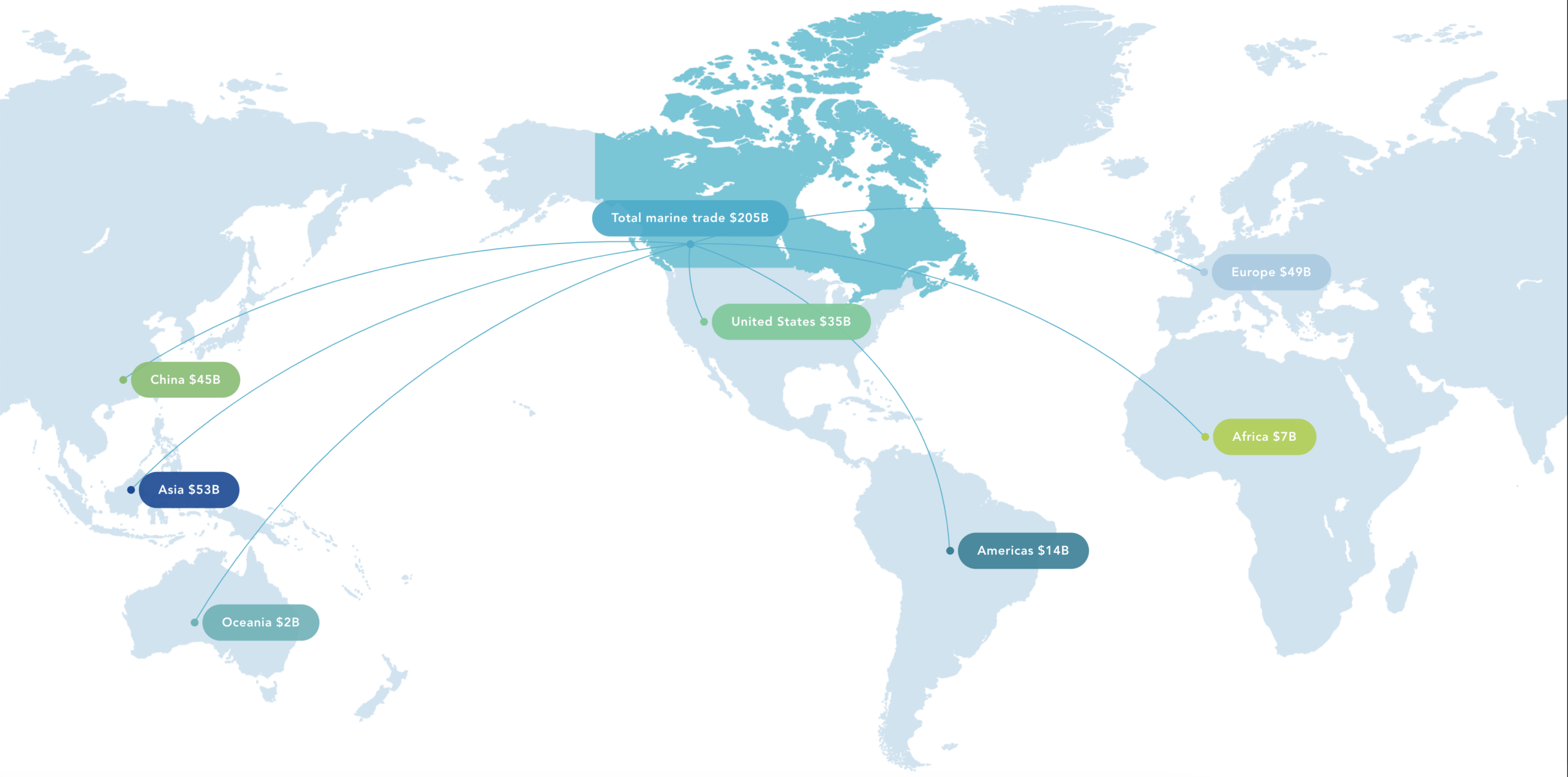
In 2015, Canada’s international marine trade totalled $205 billion – of that $93 billion was exports and $112 billion imports.
More Than a Mode of Transportation
Whether visible or not, our lives are influenced by marine shipping every day. Marine shipping gives us:
Choices as consumers
Whether it is the variety of goods available or their cost, marine shipping offers choices that benefit consumers.
Access to global markets
Canadian businesses need to sell to the world and marine shipping carries their products abroad.
Essential goods
If you live in Canada’s island or northern communities, marine shipping is often the only source you have for essentials.
Jobs and other benefits
Marine shipping directly contributes about $3 billion to Canada’s GDP through employment and other impacts.
Marine Shipping Safety
Our dependence on marine shipping necessitates that our waterways are busy hives of activity. Not unlike our hard-working roadways and rail lines – while they are indispensable to our lifestyles and our economy – safety must always be considered.
If shipping is essential to our everyday lives and all Canadians benefit from it how do we ensure that it is done to the highest standards?
What are the risks? How much risk is tolerable? Can any of that risk be avoided? Are Canadians confident that it’s being done safely?
Those are the questions that are under constant examination.
Canada’s marine safety regime is governed by the federal government. Transport Canada, the Canadian Coast Guard and their science partners at Environment and Climate Change Canada and Fisheries and Oceans Canada work together to maintain the marine safety system.
Because marine shipping, by its nature, is an international activity, there are also international regulations, that are applied to Canadian vessels and waterways, in place to ensure safety.
How marine shipping is regulated in Canada is a highly complex system of laws. Learn More. For more information on marine safety visit Transport Canada.
About Clear Seas
Clear Seas is a Canadian not-for-profit organization that provides independent fact-based information to enable governments, industry, and the public to make informed decisions on marine shipping issues. We work to build awareness and trust so that all people can feel a part of the marine sector. Our vision is a sustainable marine shipping sector that is safe, vibrant, and inclusive, both now and for future generations.
As an independent research centre, Clear Seas operates at arm’s length from our funders. Our research agenda is defined internally in response to current issues, reviewed by our research advisory committee, and approved by our board of directors.
Our board of directors is composed of mariners, scientists, community leaders, engineers and industry executives with decades of experience investigating human, environmental and economic issues related to our oceans, coastlines and waterways.
Our reports and findings are available to the public at clearseas.org